
DATADOG
Investor Presentation
February 2026

Safe harbor
This presentation and the accompanying oral presentation have been prepared by Datadog, Inc. ("Datadog" or the "company") for informational purposes only and not for any other purpose. Nothing contained in this presentation is, or should be construed as, a recommendation, promise or representation by the presenter or Datadog or any officer, director, employee, agent or advisor of Datadog. This presentation does not purport to be all-inclusive or to contain all of the information you may desire. Information provided in this presentation speaks only as of the date hereof, unless otherwise indicated.
This presentation and accompanying oral presentation contain "forward-looking" statements, as that term is defined under the federal securities laws, including but not limited to statements regarding Datadog's strategy, product and platform capabilities, the growth in and ability to capitalize on long-term market opportunities including the pace and scope of cloud migration, digital transformation and AI deployment, the potential size of the cloud, observability and other markets, gross margins and operating margins including with respect to sales and marketing, research and development expenses, capital expenditures and capitalized software, net interest and other income, tax rates and Datadog's future financial performance, including its financial guidance, outlook and goals on slides "Rapid Revenue Growth," "Financial Outlook," "Long-Term Margin Goal," "Capital Allocation Goals," and "Share Dilution." These forward-looking statements are based on Datadog's current assumptions, expectations and beliefs and are subject to substantial risks, uncertainties, assumptions and changes in circumstances that may cause Datadog's actual results, performance or achievements to differ materially from those expressed or implied in any forward-looking statement.
The risks and uncertainties referred to above include, but are not limited to (1) our recent rapid growth may not be indicative of our future growth; (2) our history of operating losses; (3) our limited operating history; (4) our dependence on existing customers purchasing additional subscriptions and products from us and renewing their subscriptions; (5) our ability to attract new customers; (6) our ability to effectively develop and expand our sales and marketing capabilities; (7) risk of a security breach; (8) risk of interruptions or performance problems associated with our products and platform capabilities; (9) our ability to adapt and respond to rapidly changing technology or customer needs; (10) the competitive markets in which we participate; (11) risks associated with successfully managing our growth, (12) risks associated with changing laws, regulations, and contractual obligations related to data privacy and security and (13) general market, political, economic, and business conditions including concerns about trade policies, tariffs, reduced economic growth and associated decreases in information technology spending. These risks and uncertainties are more fully described in our filings with the Securities and Exchange Commission (SEC), including in the section entitled "Risk Factors" in our Quarterly Report on Form 10-Q for the quarter ended September 30, 2025. Additional information will be made available in our other filings and reports that we may file from time to time with the SEC. Moreover, we operate in a very competitive and rapidly changing environment. New risks emerge from time to time. It is not possible for our management to predict all risks, nor can we assess the impact of all factors on our business or the extent to which any factor, or combination of factors, may cause actual results to differ materially from those contained in any forward-looking statements we may make. In light of these risks, uncertainties and assumptions, we cannot guarantee future results, levels of activity, performance, achievements, or events and circumstances reflected in the forward-looking statements will occur. Forward-looking statements represent our beliefs and assumptions only as of the date specified or as of this presentation, as applicable. We disclaim any obligation to update forward-looking statements.

Datadog is the AI-powered observability and security platform for cloud applications
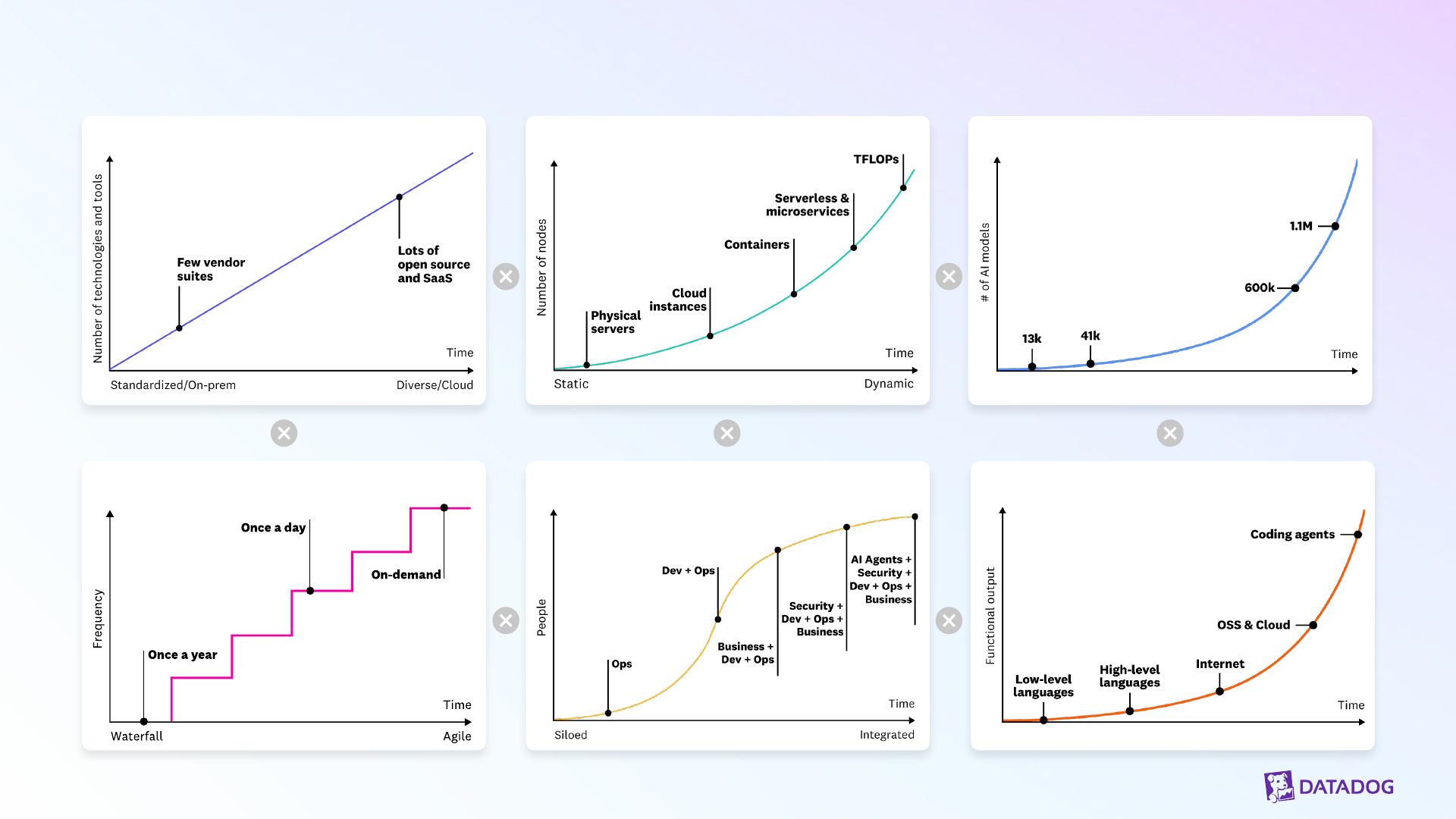
AI compounds complexity
Diversity of technologies in use | Scale in number of computing units | Number of Models on Hugging Face --- | --- | --- From few vendor suites (standardized/on-prem) to lots of open source and SaaS (diverse/cloud) | From physical servers to TFLOPs | 13k → 41k → 600k → 1.1M
Frequency of releases | Number of people involved | Developer productivity --- | --- | --- From once a year (waterfall) to on-demand (agile) | From Ops siloed to AI Agents + Security + Dev + Ops + Business integrated | From low-level languages to coding agents
Source for number of models: Hugging Face Hub Stats Dashboard, cfahlgren1, 2025.
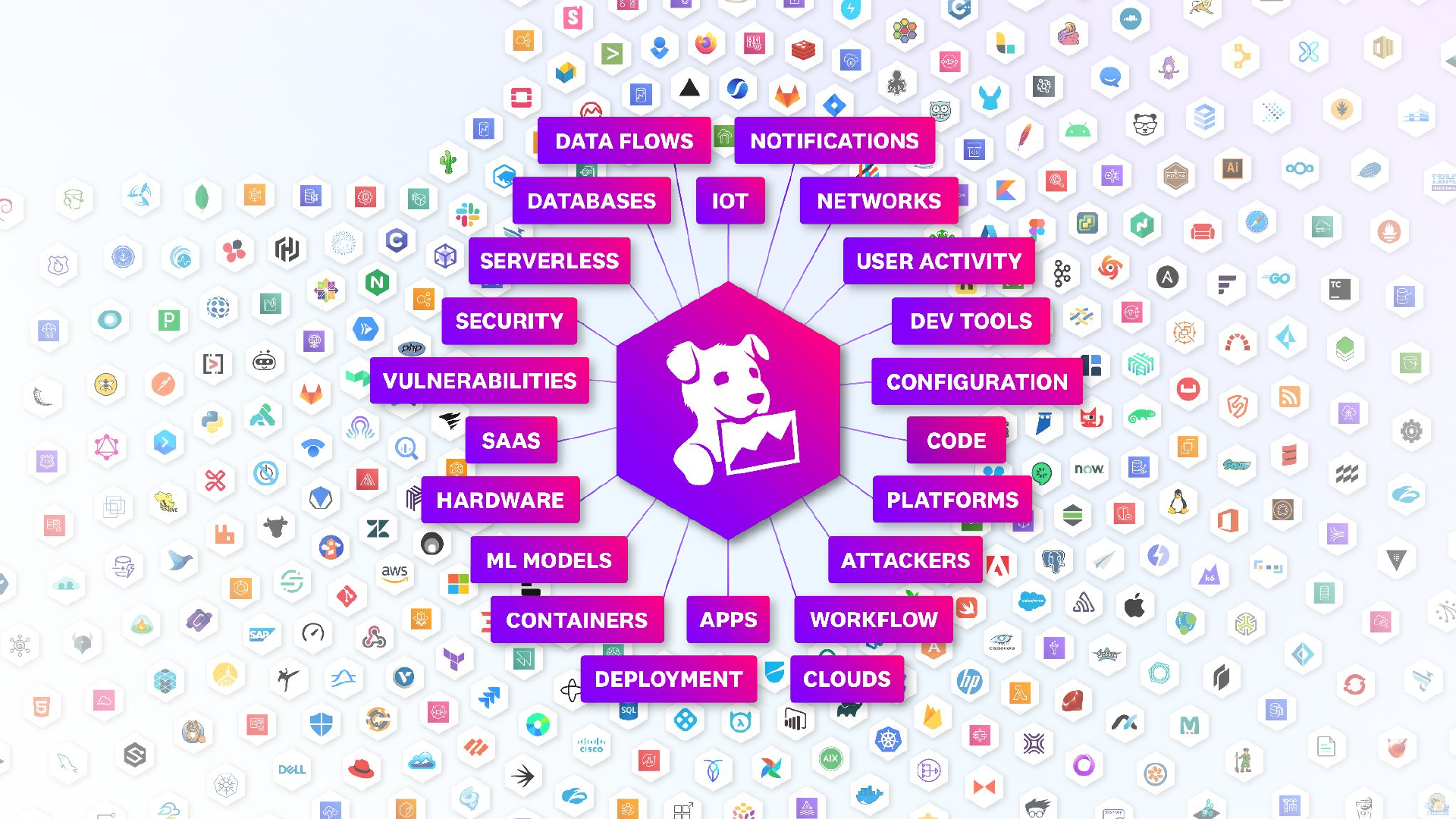
Datadog solves complexity
DATA FLOWS | NOTIFICATIONS | DATABASES | IOT | NETWORKS | SERVERLESS | USER ACTIVITY | SECURITY | DEV TOOLS | VULNERABILITIES | CONFIGURATION | SAAS | CODE | HARDWARE | PLATFORMS | ML MODELS | ATTACKERS | CONTAINERS | APPS | WORKFLOW | DEPLOYMENT | CLOUDS
Datadog breaks down silos
- Unified platform
- Simple but not simplistic
→ Deployed everywhere, used by everyone → Breaking down silos
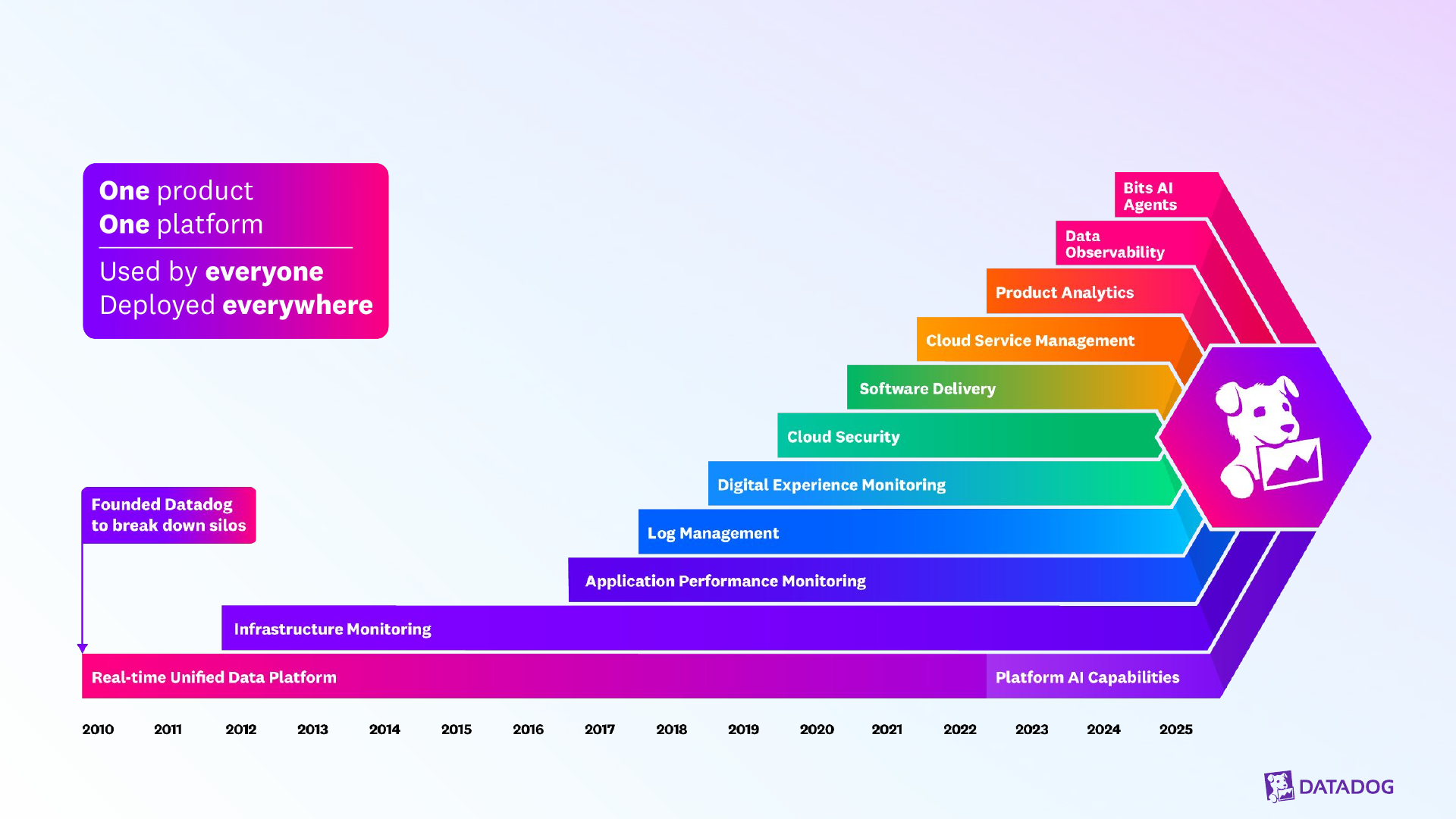
Our history of innovation
One product One platform
Used by everyone Deployed everywhere
| Year | Product Added |
|---|---|
| 2010 | Real-time Unified Data Platform |
| 2012 | Infrastructure Monitoring |
| 2016 | Application Performance Monitoring |
| 2017 | Log Management |
| 2018 | Digital Experience Monitoring |
| 2019 | Cloud Security |
| 2020 | Software Delivery |
| 2021 | Cloud Service Management |
| 2022 | Product Analytics |
| 2023 | Data Observability |
| 2024 | (continued expansion) |
| 2025 | Bits AI Agents |
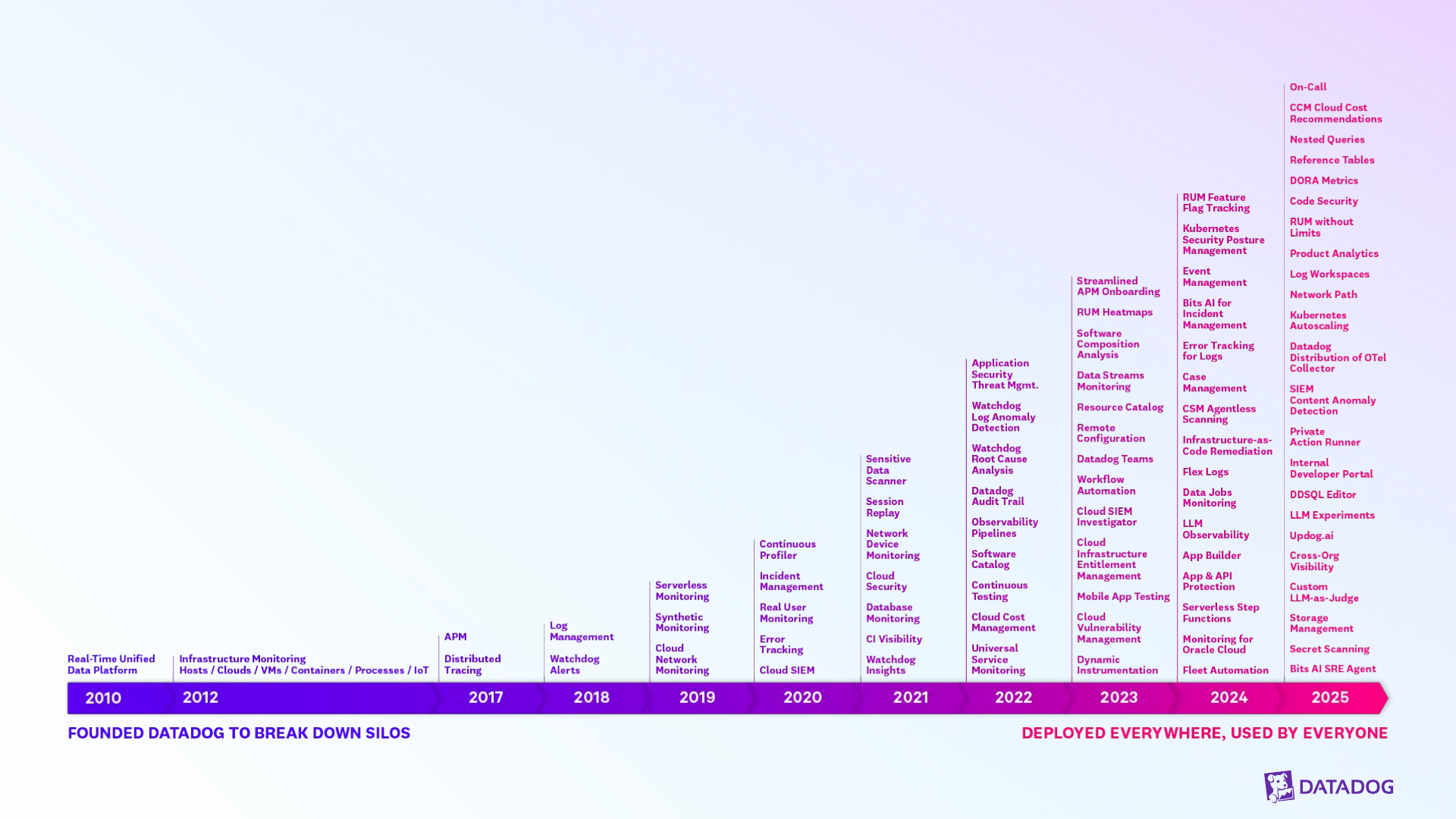
Our history of innovation
FOUNDED DATADOG TO BREAK DOWN SILOS → DEPLOYED EVERYWHERE, USED BY EVERYONE
| 2010 | 2012 | 2017 | 2018 | 2019 | 2020 | 2021 | 2022 | 2023 | 2024 | 2025 |
|---|---|---|---|---|---|---|---|---|---|---|
| Real-Time Unified Data Platform | Infrastructure Monitoring Hosts / Clouds / VMs / Containers / Processes / IoT | APM; Distributed Tracing | Log Management; Watchdog Alerts | Serverless Monitoring; Synthetic Monitoring; Cloud Network Monitoring; Cloud SIEM | Continuous Profiler; Incident Management; Real User Monitoring; Error Tracking | Sensitive Data Scanner; Session Replay; Network Device Monitoring; Cloud Security; Database Monitoring; CI Visibility; Watchdog Insights | Application Security Threat Mgmt.; Watchdog Log Anomaly Detection; Watchdog Root Cause Analysis; Datadog Audit Trail; Observability Pipelines; Software Catalog; Continuous Testing; Cloud Cost Management; Universal Service Monitoring | Streamlined APM Onboarding; RUM Heatmaps; Software Composition Analysis; Data Streams Monitoring; Resource Catalog; Remote Configuration; Datadog Teams; Workflow Automation; Cloud SIEM Investigator; Cloud Infrastructure Entitlement Management; Mobile App Testing; Cloud Vulnerability Management; Dynamic Instrumentation | RUM Feature Flag Tracking; Kubernetes Security Posture Management; Event Management; Bits AI for Incident Management; Error Tracking for Logs; Case Management; CSM Agentless Scanning; Infrastructure-as-Code Remediation; Flex Logs; Data Jobs Monitoring; LLM Observability; App Builder; App & API Protection; Serverless Step Functions; Monitoring for Oracle Cloud; Fleet Automation | On-Call; CCM Cloud Cost Recommendations; Nested Queries; Reference Tables; DORA Metrics; Code Security; RUM without Limits; Product Analytics; Log Workspaces; Network Path; Kubernetes Autoscaling; Datadog Distribution of OTel Collector; SIEM Content Anomaly Detection; Private Action Runner; Internal Developer Portal; DDSQL Editor; LLM Experiments; Updog.ai; Cross-Org Visibility; Custom LLM-as-Judge; Storage Management; Secret Scanning; Bits AI SRE Agent |
Datadog Platform
Infrastructure
- Infrastructure Monitoring
- Metrics
- Container Monitoring
- Serverless
- Cloud Network Monitoring
- Network Device Monitoring
- Cloud Cost Management
- Cloudcraft
Applications
- Application Performance Monitoring
- Distributed Tracing
- Continuous Profiler
- Universal Service Monitoring
- LLM Observability
- Database Monitoring
- Data Streams Monitoring
Data Observability
- Jobs Monitoring
- Quality Monitoring
Logs
- Log Management
- Flex Logs
- Observability Pipelines
- Audit Trail
- Log Forwarding
Digital Experience
- Synthetics Testing & Monitoring
- Browser Real User Monitoring
- Mobile Real User Monitoring
- Session Replay
- Product Analytics
Security
- Cloud Security
- Code Security
- Cloud SIEM
- Sensitive Data Scanner
- Workload Protection
- App and API Protection
Software Delivery
- CI Visibility
- Test Optimization
- Continuous Testing
- Error Tracking
- Feature Flags
Service Management
- On-Call
- Incident Management
- Event Management
- Workflow Automation
- App Builder
- Bits AI SRE Agent
AI: Natural Language Querying ● Root Cause Analysis ● Anomaly Detection ● Impact Analysis ● Proactive Alerts ● Autonomous Investigations ● Bits AI
Shared Platform Services: Dashboards ● CoScreen ● Teams ● Agent ● OpenTelemetry ● Notebooks ● Software Catalog ● IDE Plugins ● ChatOps ● SLOs ● Case Management
UNIFIED METRICS, LOGS, TRACES, SESSIONS
1,000+ INTEGRATIONS
Cloud migration and digital transformation
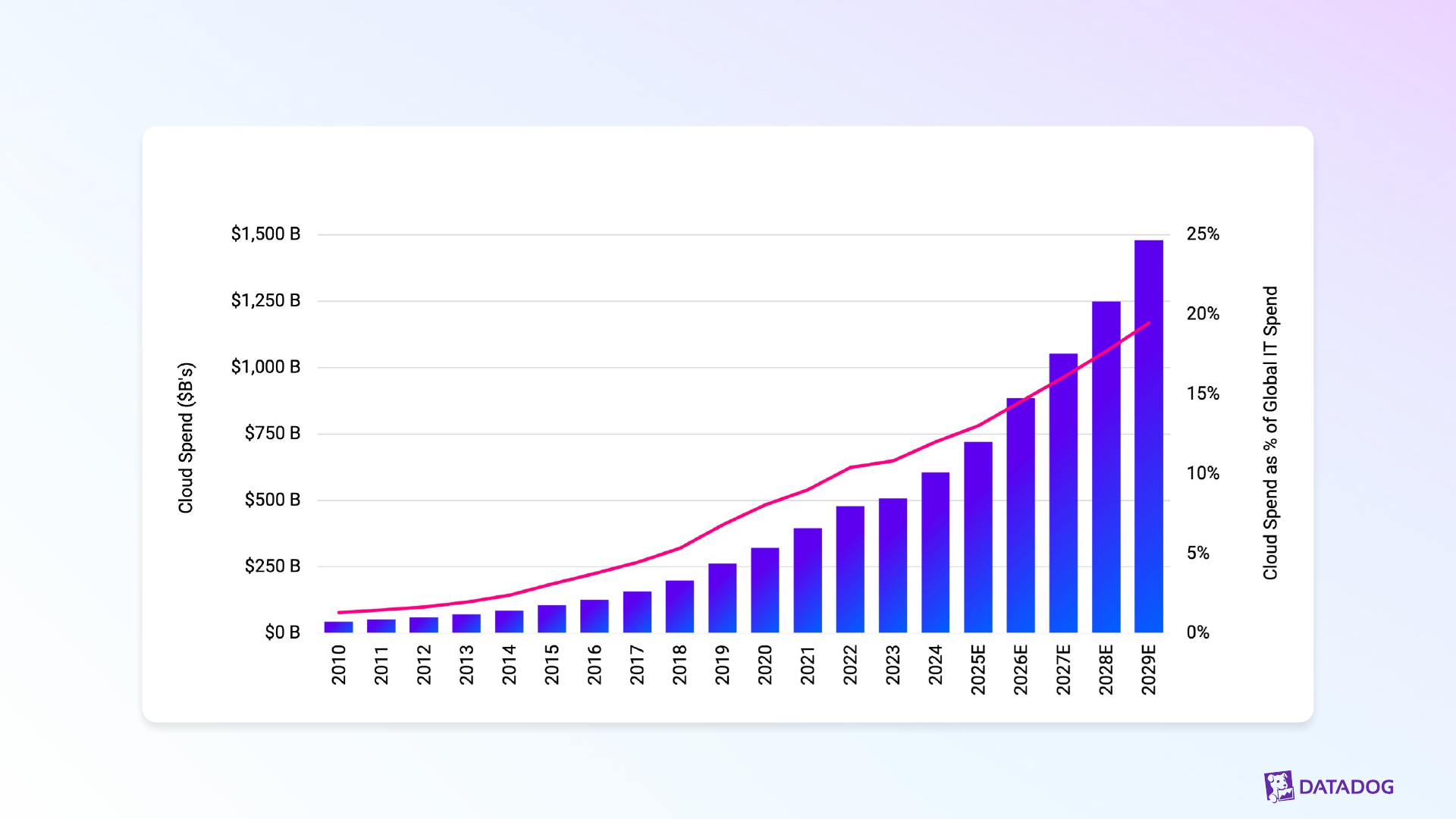
Cloud spend continues to grow rapidly
| Year | Cloud Spend (approx.) |
|---|---|
| 2010 | ~$0B |
| 2015 | ~$100B |
| 2018 | ~$200B |
| 2019 | ~$250B |
| 2020 | ~$300B |
| 2021 | ~$350B |
| 2022 | ~$475B |
| 2023 | ~$525B |
| 2024 | ~$650B |
| 2025E | ~$800B |
| 2026E | ~$875B |
| 2027E | ~$1,050B |
| 2028E | ~$1,275B |
| 2029E | ~$1,425B |
Source: Gartner Forecast: Public Cloud Services, Worldwide - 2010-2016, 4Q12 Update; 2011-2017, 4Q13 Update; 2012-2018, 4Q14 Update; 2013-2019, 4Q15 Update; 2014-2020, 4Q16 Update; 2015-2021, 4Q17 Update; 2016-2022, 4Q18 Update; 2017-2023, 4Q19 Update; 2018-2024, 4Q20 Update; 2019-2025, 4Q21 Update; 2020-2026, 4Q22 Update; 2021-2027, 4Q23 Update; 2022-2028, 4Q24 Update; 2023-2029, 3Q25 Update. Gartner Market Databook - 4Q12 Update; 4Q13 Update; 4Q14 Update; 4Q15 Update; 4Q16 Update; 4Q17 Update; 4Q18 Update; 4Q19 Update; 4Q20 Update; 4Q21 Update; 4Q22 Update; 4Q23 Update; 4Q24 Update; 4Q25 Update.
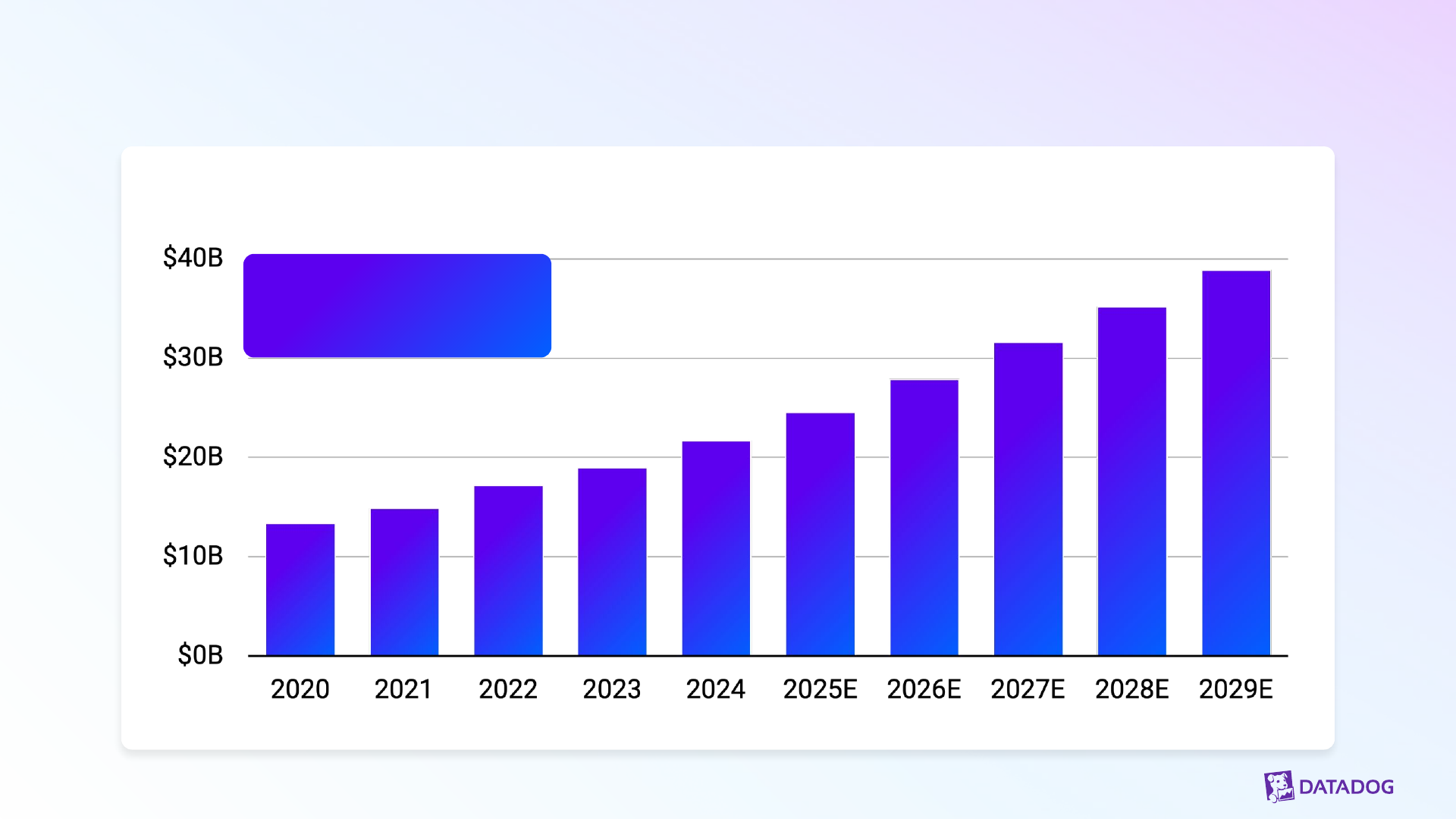
Large and Growing Observability TAM
Gartner Health & Performance Analytics category, 2020-2029E
> Our Observability market is $28B in 2026E
| Year | Market Size (approx.) |
|---|---|
| 2020 | ~$13B |
| 2021 | ~$15B |
| 2022 | ~$17B |
| 2023 | ~$19B |
| 2024 | ~$22B |
| 2025E | ~$25B |
| 2026E | ~$28B |
| 2027E | ~$31B |
| 2028E | ~$35B |
| 2029E | ~$38B |
Source: Gartner Forecast: Enterprise Infrastructure Software, Worldwide - 2020-2026, 4Q22 Update; 2021-2027, 4Q23 Update; 2022-2028, 4Q24 Update; 2023-2029; 4Q25 Update. Gartner Health & Performance Analytics category, 2020-2029E
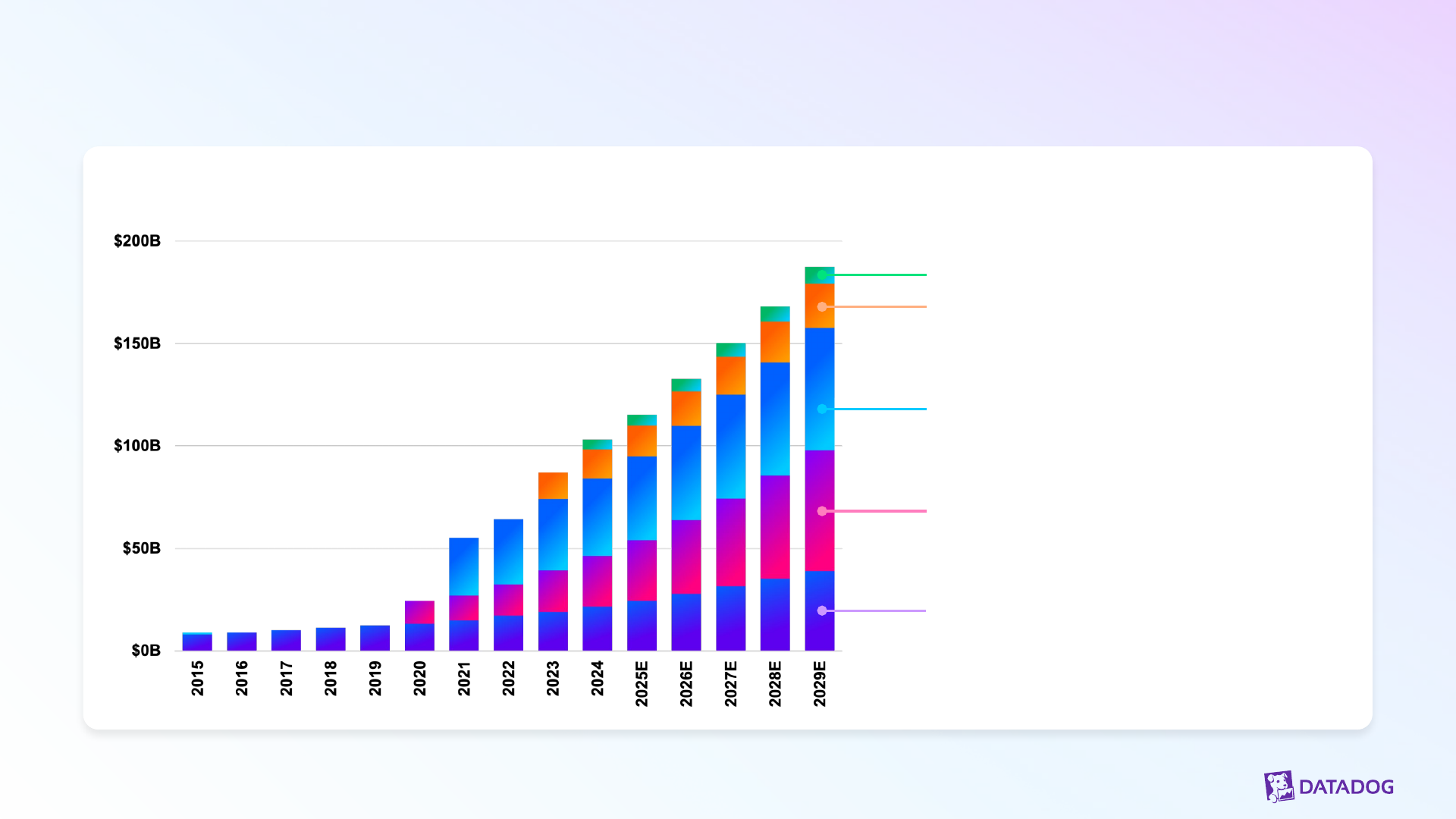
We are adding multiple markets
Datadog market opportunity by major product area
Observability Infrastructure Monitoring, APM, Log Management, Synthetics, RUM, Network Monitoring, LLM Observability, AI Agents Console, and more
Security Cloud Security, Code Security, Cloud SIEM, Data Security, Bits AI Security Agent, and more
Software Delivery CI Visibility, Test Optimization, Continuous Testing, Bits AI Dev Agent, Datadog MCP Server, and more
Service Management OnCall, Incident Management, Workflow Automation, Bits AI SRE Agent, and more
Product Analytics
Source: Gartner Forecast: Enterprise Infrastructure Software, Worldwide - 2015-2021, 4Q17 Update; 2016-2022, 4Q18 Update; 2017-2023, 4Q19 Update; 2018-2024, 4Q20 Update; 2019-2025, 4Q21 Update; 2020-2026, 4Q22 Update; 2021-2027, 4Q23 Update; 2022-2028, 4Q24 Update; 2023-2029; 4Q25 Update. Gartner Forecast: Enterprise Application Software, Worldwide - 2015-2021, 4Q17 Update; 2016-2022, 4Q18 Update; 2017-2023, 4Q19 Update; 2018-2024, 4Q20 Update; 2019-2025, 4Q21 Update; 2020-2026, 4Q22 Update; 2021-2027, 4Q23 Update; 2022-2028, 4Q24 Update; 2023-2029; 4Q25 Update. Gartner Forecast: Information Security, Worldwide - 2015-2021, 4Q17 Update; 2016-2022, 4Q18 Update; 2017-2023, 4Q19 Update; 2018-2024, 4Q20 Update; 2019-2025, 4Q21 Update; 2020-2026, 4Q22 Update; 2021-2027, 4Q23 Update; 2022-2028, 4Q24 Update; 2023-2029; 4Q25 Update.
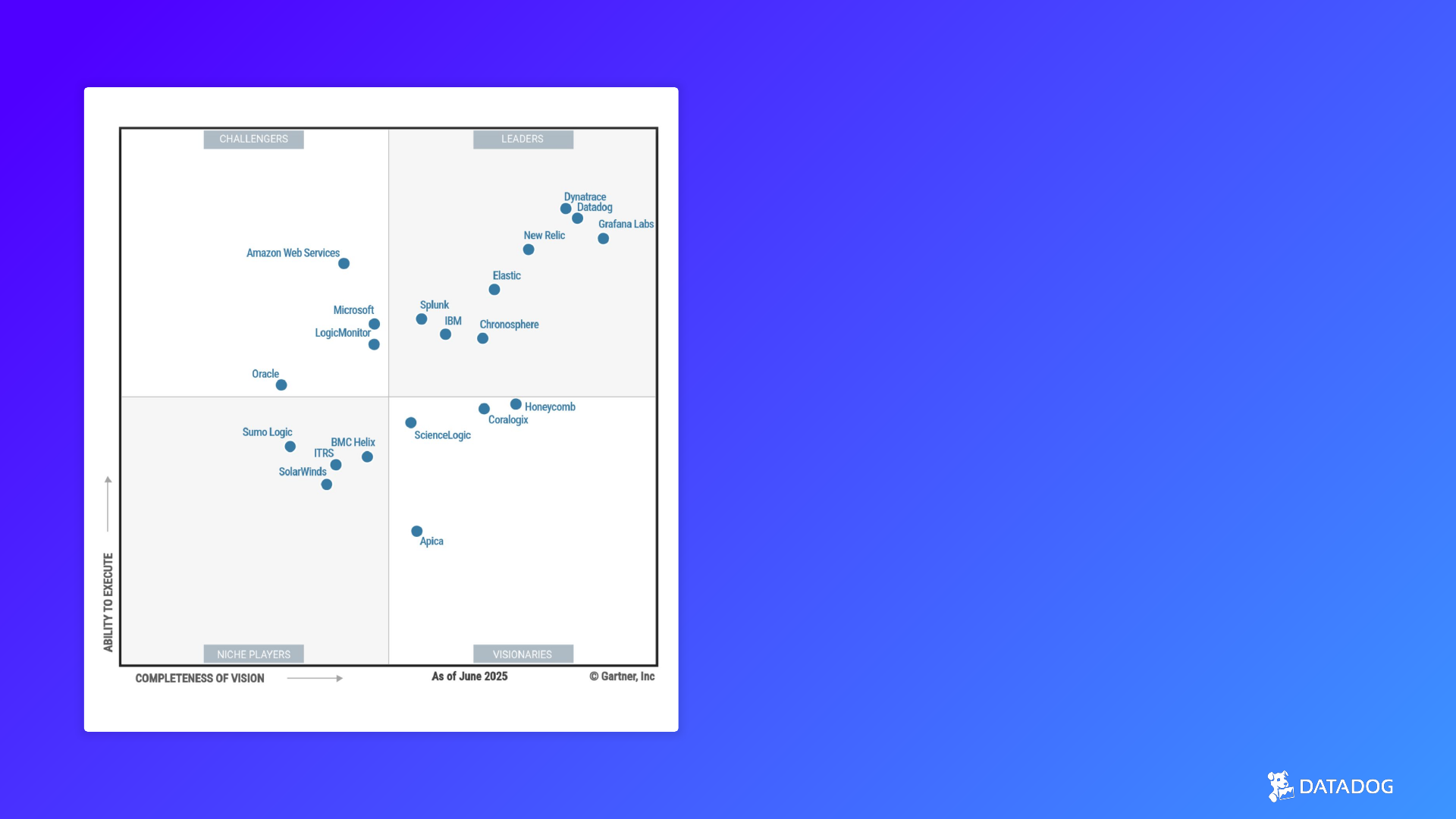
INDUSTRY RECOGNITION
Datadog named a Leader in the 2025 Gartner® Magic Quadrant™ for Observability Platforms
This graphic was published by Gartner, Inc. as part of a larger research document and should be evaluated in the context of the entire document. The Gartner document is available upon request from Datadog.
Gartner does not endorse any vendor, product or service depicted in its research publications, and does not advise technology users to select only those vendors with the highest ratings or other designation. Gartner research publications consist of the opinions of Gartner's research organization and should not be construed as statements of fact. Gartner disclaims all warranties, express or implied, with respect to this research, including any warranties of merchantability or fitness for a particular purpose.
Gartner and Magic Quadrant are registered trademarks of Gartner, Inc. and/or its affiliates in the U.S. and internationally and is used herein with permission. All rights reserved.
The Gartner content described herein (the "Gartner Content") represents research opinion or viewpoints published, as part of a syndicated subscription service, by Gartner, Inc. ("Gartner"), and is not a representation of fact. Gartner Content speaks as of its original publication date (and not as of the date of this Earnings Report), and the opinions expressed in the Gartner Content are subject to change without notice.
Source: Gartner, Magic Quadrant for Observability Platforms, Gregg Siegfried, Padraig Byrne, Andre Bridges, Martin Caren, 7 July 2025
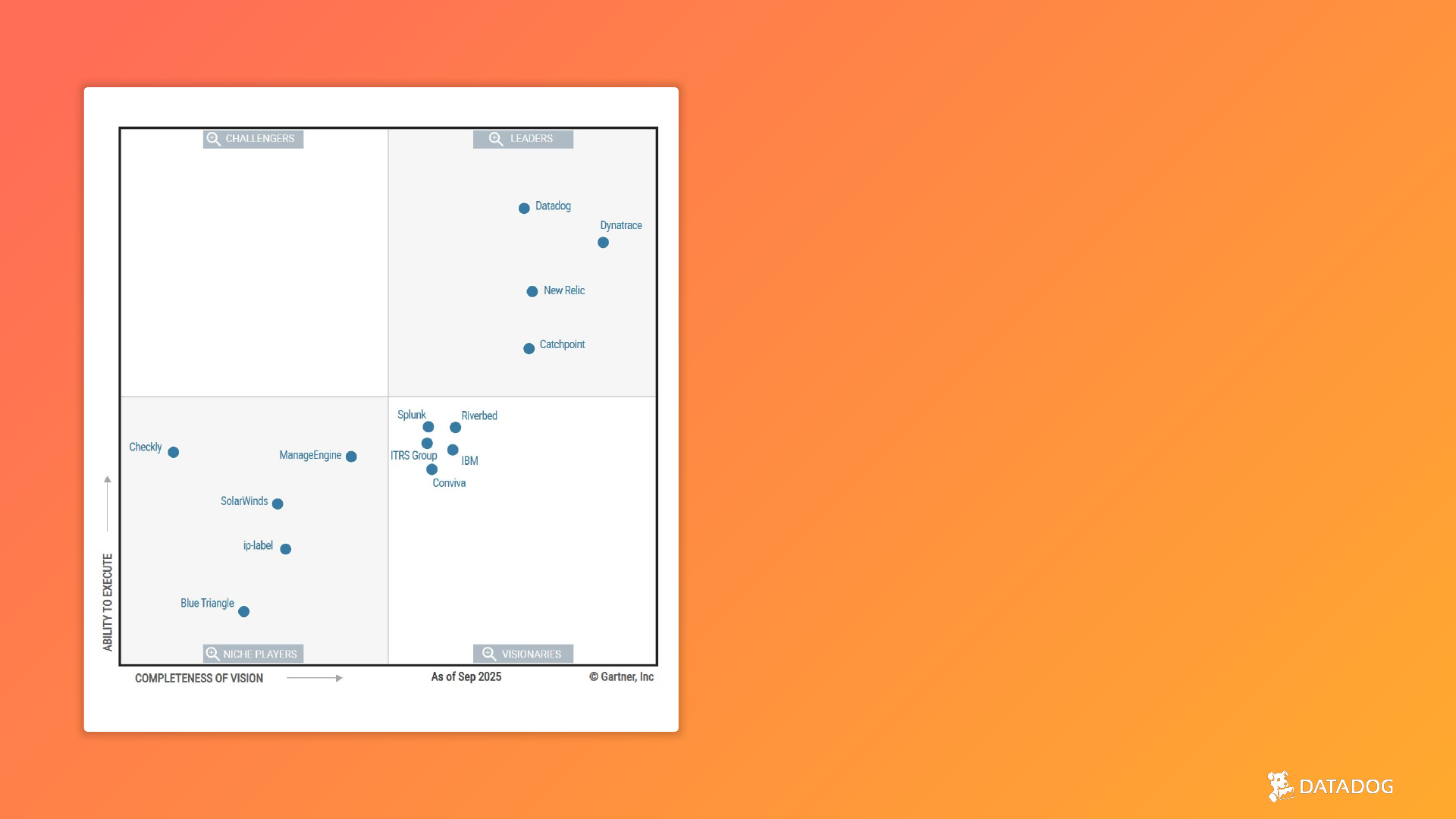
INDUSTRY RECOGNITION
Datadog named a Leader in the 2025 Gartner® Magic Quadrant™ for Digital Experience Monitoring
This graphic was published by Gartner, Inc. as part of a larger research document and should be evaluated in the context of the entire document. The Gartner document is available upon request from Datadog.
Gartner does not endorse any vendor, product or service depicted in its research publications, and does not advise technology users to select only those vendors with the highest ratings or other designation. Gartner research publications consist of the opinions of Gartner's research organization and should not be construed as statements of fact. Gartner disclaims all warranties, express or implied, with respect to this research, including any warranties of merchantability or fitness for a particular purpose.
Gartner and Magic Quadrant are registered trademarks of Gartner, Inc. and/or its affiliates in the U.S. and internationally and is used herein with permission. All rights reserved.
The Gartner content described herein (the "Gartner Content") represents research opinion or viewpoints published, as part of a syndicated subscription service, by Gartner, Inc. ("Gartner"), and is not a representation of fact. Gartner Content speaks as of its original publication date (and not as of the date of this Earnings Report), and the opinions expressed in the Gartner Content are subject to change without notice.
Source: Gartner, Magic Quadrant for Digital Experience Monitoring, Padraig Byrne, Matt Crossley, DB Cummings, Martin Caren, Pankaj Prasad, Tanmay Bisht, 27 October 2025
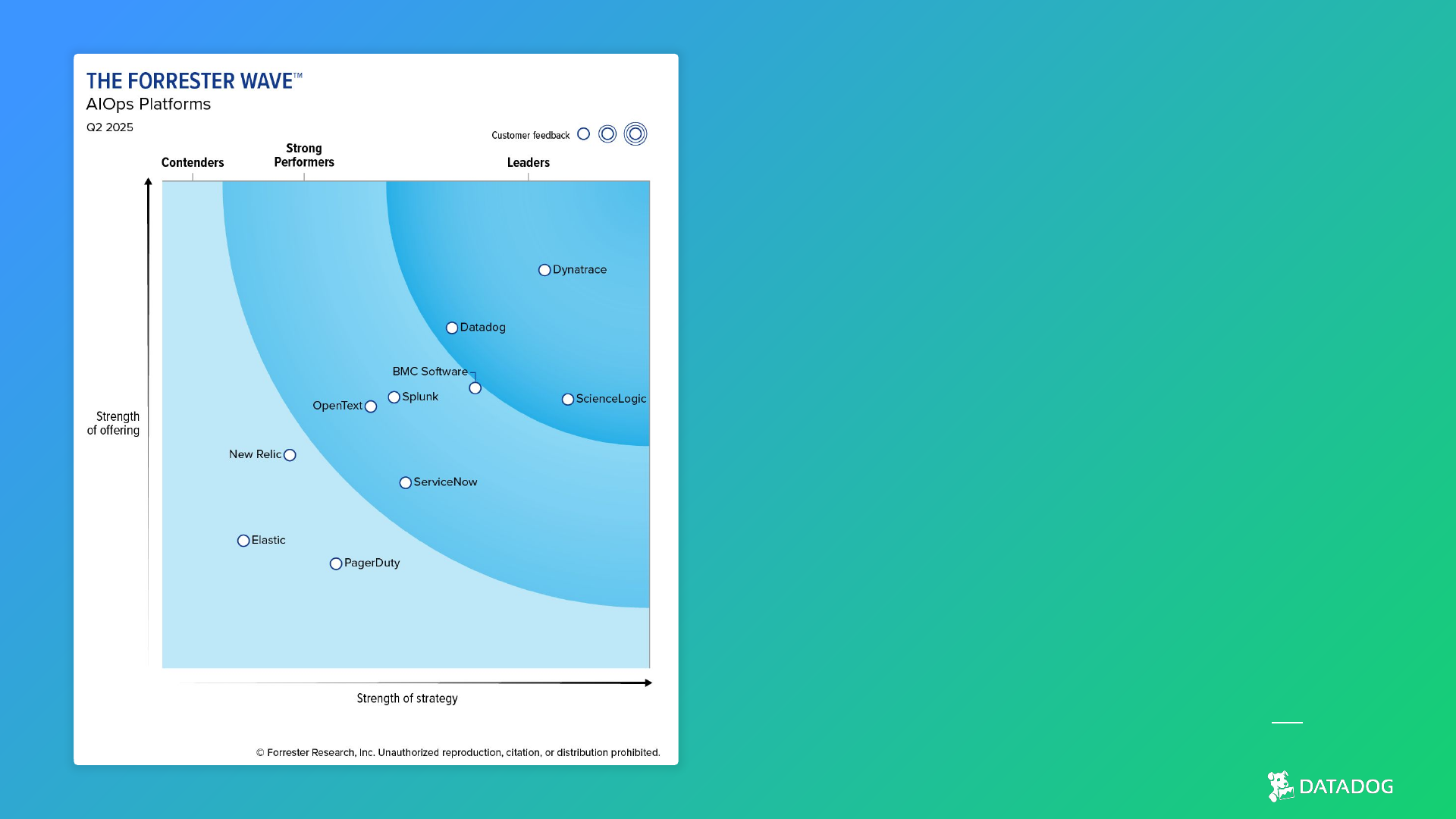
INDUSTRY RECOGNITION
Datadog named a Leader in The Forrester Wave™: AIOps Platforms, Q2 2025
Forrester does not endorse any company, product, brand, or service included in its research publications and does not advise any person to select the products or services of any company or brand based on the ratings included in such publications. Information is based on the best available resources. Opinions reflect judgment at the time and are subject to change. For more information, read about Forrester's objectivity here.
Datadog scales across ~32,700 global customers
Customers who are transforming + Customers who are born in cloud
Trillions of data points per/hr
(1) Customers as of September 2025.
Financial overview

Datadog today (1)
FINANCIAL
$3.43B TTM revenue | +28% TTM Y/Y growth
22% TTM non-GAAP operating margin
27% TTM free cash flow margin
About 120% Dollar-based TTM net retention rate
$4.5B Cash, cash equivalents, and marketable securities
CUSTOMERS
~32,700 Total customers
~4,310 $100k+ ARR customers
PLATFORM ADOPTION
55% Customers using 4+ products 33% Customers using 6+ products 18% Customers using 8+ products 9% Customers using 10+ products
PEOPLE
~8,100 in 35 countries(2)
25 PRODUCTS IN AN INTEGRATED DATA PLATFORM
Infra Monitoring
- Infra Monitoring
- Cloud Cost Mgmt
- Networking Monitoring
Log Management
- Log Management
- Observability Pipelines
Security
- Cloud Security
- Code Security
- Cloud SIEM
- Data Security
Application Performance Monitoring
- Application Performance Monitoring
- Database Monitoring
- Continuous Profiler
- LLM Observability
- Data Observability
Cloud Service Management
- OnCall
- Incident Mgmt
- Bits AI SRE Agent
- Event Mgmt
- Workflow Automation
Digital Experience Monitoring
- Synthetic Monitoring
- Product Analytics
- Real User Monitoring
- Error Tracking
Software Delivery
- CI Visibility
- Feature Flags
We were named a Leader in the Gartner® Magic Quadrants for Observability Platforms (2025) and Digital Experience Monitoring (2025)
(1) All data as of December 31, 2025. Non-GAAP operating margin and free cash flow margin are non-GAAP measures. See Appendix for a reconciliation to financial results prepared in accordance with GAAP. (2) Employee headcount as of December 31, 2025.

Our growth drivers
- Secular tailwind of digital transformation and cloud migration
- Deployment of GenAI and agentic applications driving cloud usage
- Growing and retaining customers
- Expanding products / use cases for customers
- Adding new markets beyond Observability
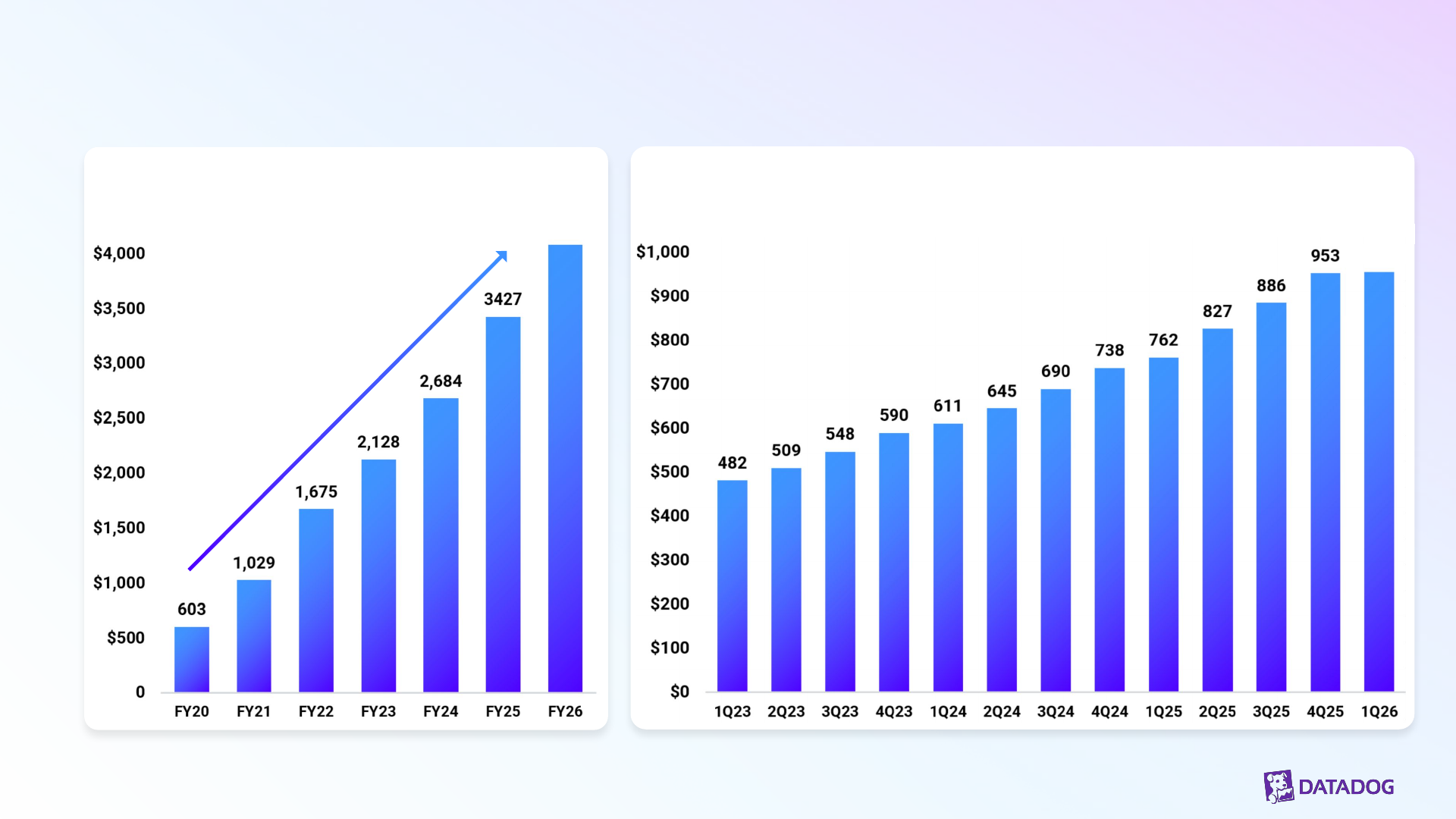
Rapid revenue growth
Annual revenue $M's
| Fiscal Year | Revenue |
|---|---|
| FY20 | $603M |
| FY21 | $1,029M |
| FY22 | $1,675M |
| FY23 | $2,128M |
| FY24 | $2,684M |
| FY25 | $3,427M |
| FY26 (Guided)(1) | $4,060–4,100M |
38% CAGR
Quarterly revenue $M's
| Quarter | Revenue |
|---|---|
| 1Q23 | 482 |
| 2Q23 | 509 |
| 3Q23 | 548 |
| 4Q23 | 590 |
| 1Q24 | 611 |
| 2Q24 | 645 |
| 3Q24 | 690 |
| 4Q24 | 738 |
| 1Q25 | 762 |
| 2Q25 | 827 |
| 3Q25 | 886 |
| 4Q25 | 953 |
| 1Q26 (Guided)(1) | 951–961 |
(1) Guided revenues are forward-looking statements as of February 10, 2026. See Safe Harbor for important information about these assumptions and forward-looking statements.
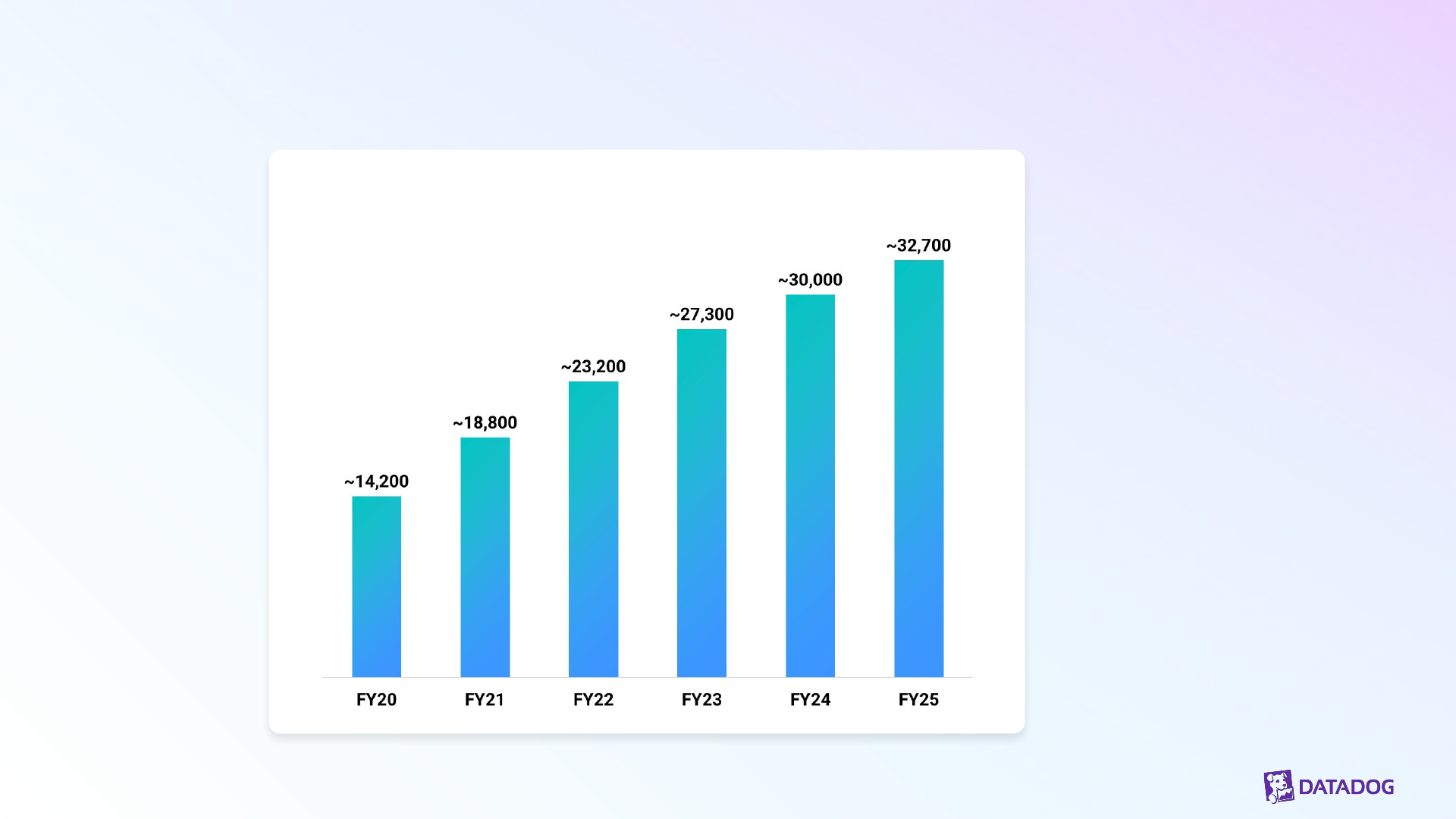
Strong customer growth
Total customers
| Fiscal Year | Total Customers |
|---|---|
| FY20 | ~14,200 |
| FY21 | ~18,800 |
| FY22 | ~23,200 |
| FY23 | ~27,300 |
| FY24 | ~30,000 |
| FY25 | ~32,700 |
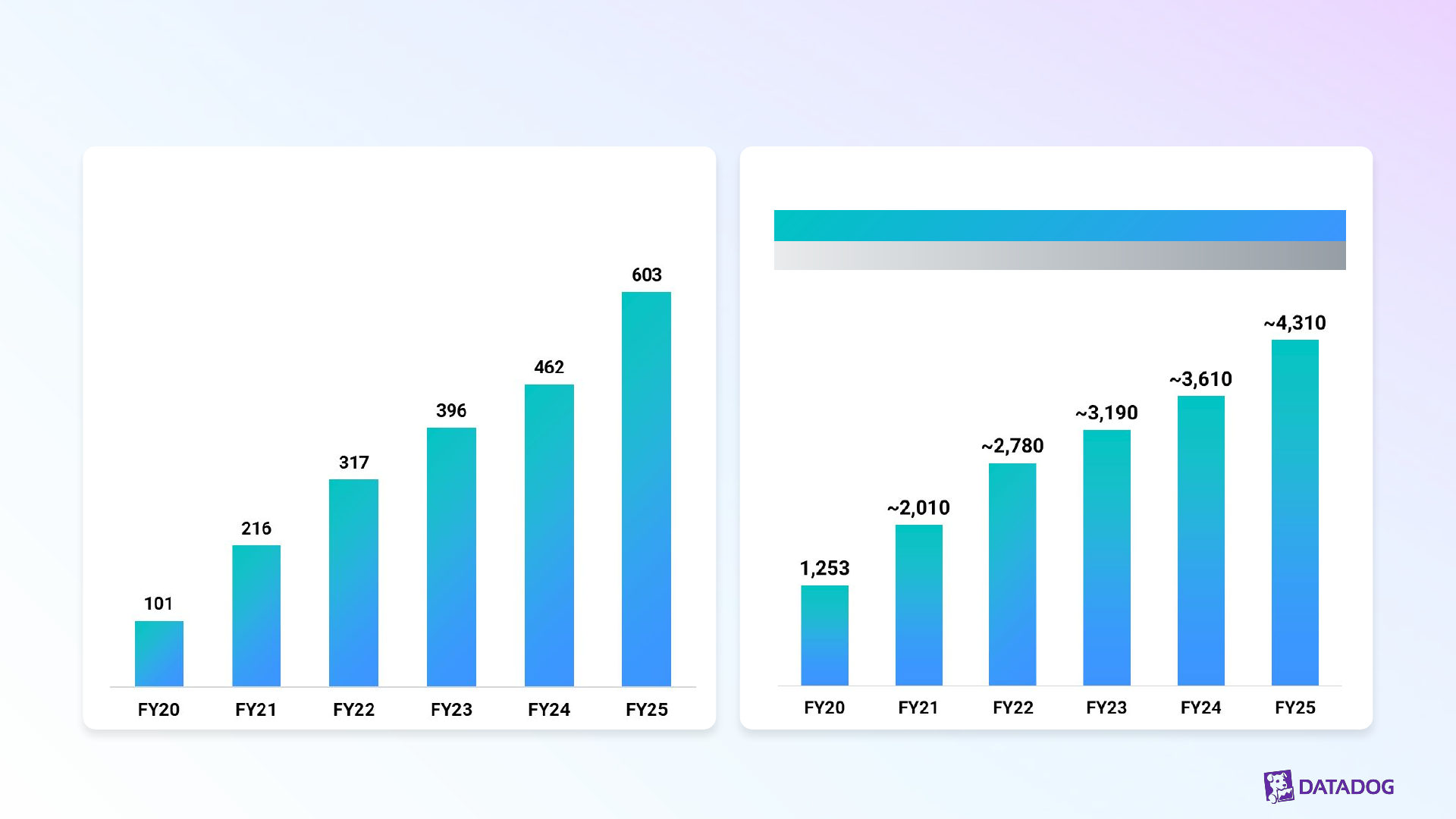
Strong customer growth
# of customers with ARR $1M+
| Fiscal Year | $1M+ ARR Customers | $100K+ ARR Customers | % of Total ARR |
|---|---|---|---|
| FY20 | 101 | 1,253 | 78% |
| FY21 | 216 | ~2,010 | 83% |
| FY22 | 317 | ~2,780 | 85% |
| FY23 | 396 | ~3,190 | 86% |
| FY24 | 462 | ~3,610 | 88% |
| FY25 | 603 | ~4,310 | 90% |
See our Annual Report on Form 10-K for the year-ended December 31, 2025 for the definition of ARR.
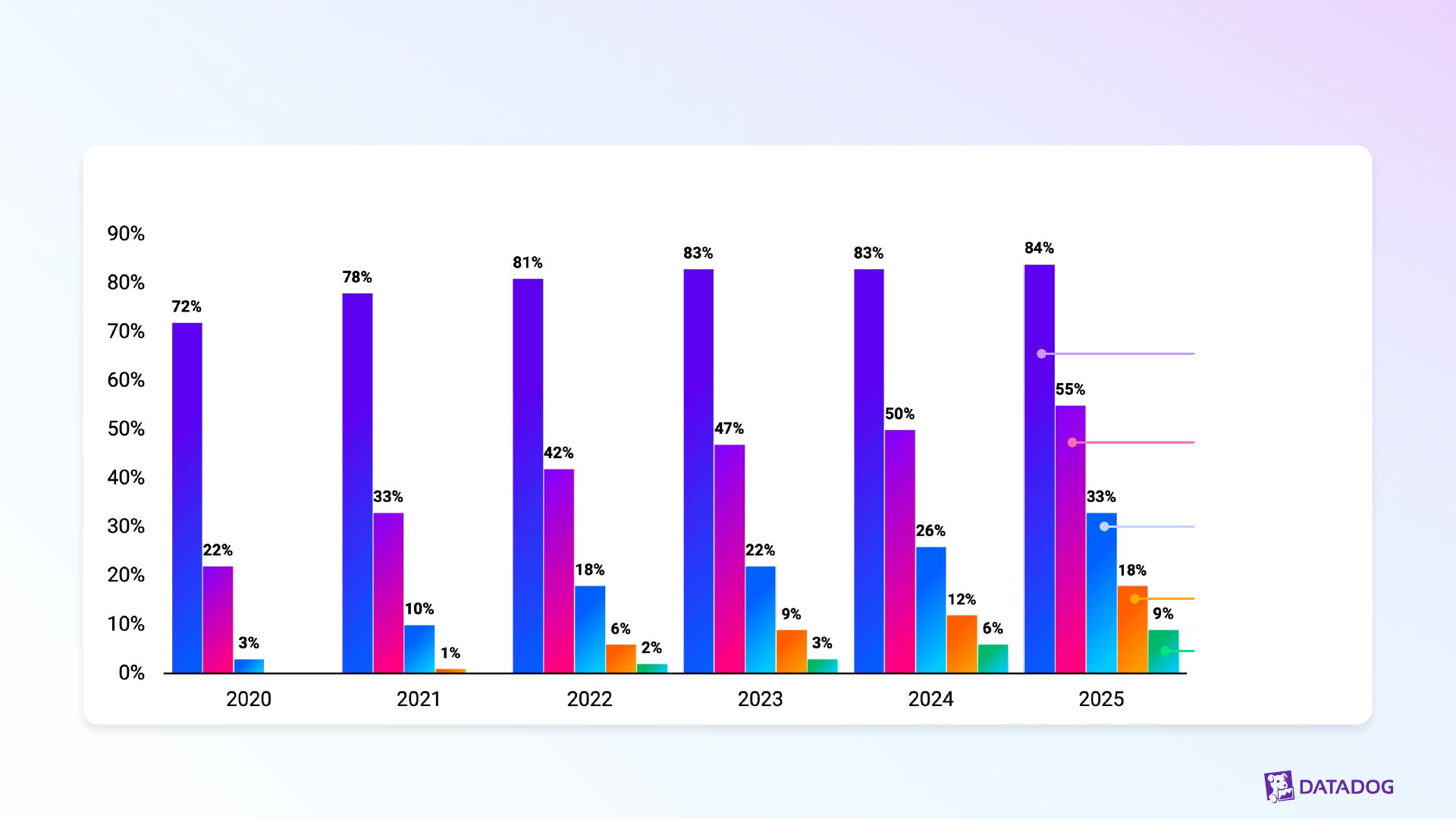
Multi-Product Adoption
Multi-product adoption
| Year | 2+ Products | 4+ Products | 6+ Products | 8+ Products | 10+ Products |
|---|---|---|---|---|---|
| 2020 | 72% | 22% | 3% | — | — |
| 2021 | 78% | 33% | 10% | 1% | — |
| 2022 | 81% | 42% | 18% | 6% | 2% |
| 2023 | 83% | 47% | 22% | 9% | 3% |
| 2024 | 83% | 50% | 26% | 12% | 6% |
| 2025 | 84% | 55% | 33% | 18% | 9% |

Strong retention and upsell
Mid-to-high 90%s Dollar-based gross retention rate
About 120% Dollar-based net retention rate
As of December 31, 2025. See Appendix for more information regarding gross retention rate and net retention rate.
Financial summary
| FY20 | FY21 | FY22 | FY23 | FY24 | FY25 | |
|---|---|---|---|---|---|---|
| Revenue | $603M | $1,029M | $1,675M | $2,128M | $2,684M | $3,427M |
| % Y/Y growth | 66% | 70% | 63% | 27% | 26% | 28% |
| Gross margin(1) | 79% | 78% | 80% | 82% | 82% | 81% |
| Research & development margin(1) | 29% | 30% | 30% | 30% | 28% | 30% |
| Sales & marketing margin(1) | 31% | 25% | 25% | 24% | 23% | 23% |
| General & administrative margin(1) | 8% | 7% | 6% | 6% | 5% | 5% |
| Operating profit(1) | $64M | $165M | $326M | $490M | $674M | $768M |
| Operating margin(1) | 11% | 16% | 19% | 23% | 25% | 22% |
| Free cash flow(1) | $83M | $251M | $354M | $598M | $775M | $915M |
| Free cash flow margin(1) | 14% | 24% | 21% | 28% | 29% | 27% |
(1) Non-GAAP measures. See Appendix for a reconciliation of these non-GAAP measures to the most directly comparable GAAP measures.

Financial outlook (as of February 10, 2026) (1)
| 1Q26 | FY26 | |
|---|---|---|
| Revenue | $951–961M | $4,060–4,100M |
| Non-GAAP operating income(2) | $195–205M | $840–880M |
| Non-GAAP EPS(2) | $0.49–0.51 | $2.08–2.16 |
| Weighted average diluted shares | Approx. 367M | Approx. 372M |
(1) Financial outlook are forward-looking statements. See Safe Harbor for important information about these assumptions and forward-looking statements. (2) See Appendix for information about these non-GAAP measures.

Long-term margin goal
| Non-GAAP %(1) | 2019 | 2020 | 2021 | 2022 | 2023 | 2024 | 2025 | Goal |
|---|---|---|---|---|---|---|---|---|
| Operating Margin | -1% | 11% | 16% | 19% | 23% | 25% | 22% | 25%+ |
| Free Cash Flow Margin | 0% | 14% | 24% | 21% | 28% | 29% | 27% |
(1) Non-GAAP measures. See Appendix for a reconciliation of these non-GAAP measures to the most directly comparable GAAP measures.
Operating Margin Goal is a forward-looking statement and speaks as of our Investor Day on February 12, 2026. See Safe Harbor for important information about these assumptions and forward-looking statements.

Capital allocation goals
- Generate healthy amounts of FCF
- Ensure our leadership has flexibility and capacity to invest
- Maintain our thoughtful and disciplined acquisition strategy

Share dilution
2.5–3.0%
Target net dilution related to RSUs/PSUs awarded (1)
(1) Defined as % of weighted average shares outstanding granted as equity awards (options, RSUs, PSUs, etc.) during the period, net of forfeitures and cancellations.
Target net dilution is a forward-looking statement. See Safe Harbor for important information about these assumptions and forward-looking statements.
Appendix
Non-GAAP financial measures and other information
The statistical data, estimates and forecasts referenced in this presentation and the accompanying oral presentation are based on independent industry publications or other publicly available information, as well as information based on our internal sources. While we believe the industry and market data included in this presentation and the accompanying oral presentation are reliable and are based on reasonable assumptions, these data involve many assumptions and limitations, and you are cautioned not to give undue weight to these estimates. We have not independently verified the accuracy or completeness of the data contained in these industry publications and other publicly available information.
We define the number of customers as the number of accounts with a unique account identifier for which we have an active subscription in the period indicated. Users of our free trials or tier are not included in our customer count. A single organization with multiple divisions, segments or subsidiaries is generally counted as a single customer. However, in some cases where they have separate billing terms, we may count separate divisions, segments or subsidiaries as multiple customers. Customers as of December 31, 2022 exclude customers from a then-recent acquisition, which did not contribute meaningful revenue during the fiscal year. Other terms such as annual recurring revenue or ARR and dollar-based net revenue retention rate shall have the meanings set forth in our Annual Report. Dollar-based gross retention rate is calculated by first calculating the point-in-time gross retention as the previous year ARR minus ARR attrition over the last 12 months, divided by the previous year ARR. The ARR attrition for each month is calculated by identifying any customer that has changed their account type to a "free tier," requested a downgrade through customer support or sent a formal termination notice to us during that month, and aggregating the dollars of ARR generated by each such customer in the prior month. We then calculate the dollar-based gross retention rate as the weighted average of the trailing 12-month point-in-time gross retention rates. We believe dollar-based gross retention rate demonstrates the stickiness of the product category we operate in, and of our platform in particular.
Non-GAAP Financial Measures
Datadog discloses the following non-GAAP financial measures in this presentation and the accompanying oral presentation: non-GAAP gross profit, non-GAAP gross margin, non-GAAP operating expenses (sales and marketing, research and development, general and administrative), non-GAAP operating income (loss), non-GAAP operating margin, non-GAAP net income (loss), non-GAAP net income (loss) per diluted share, non-GAAP net income (loss) per basic share, free cash flow and free cash flow margin. Datadog uses each of these non-GAAP financial measures internally to understand and compare operating results across accounting periods, for internal budgeting and forecasting purposes, for short- and long-term operating plans, and to evaluate Datadog's financial performance. Datadog believes they are useful to investors, as a supplement to GAAP measures, in evaluating its operational performance, as further discussed below. Datadog's non-GAAP financial measures may not provide information that is directly comparable to that provided by other companies in its industry, as other companies in its industry may calculate non-GAAP financial results differently, particularly related to non-recurring and unusual items. In addition, there are limitations in using non-GAAP financial measures because the non-GAAP financial measures are not prepared in accordance with GAAP and may be different from non-GAAP financial measures used by other companies and exclude expenses that may have a material impact on Datadog's reported financial results.
Non-GAAP financial measures should not be considered in isolation from, or as a substitute for, financial information prepared in accordance with GAAP. A reconciliation of the historical non-GAAP financial measures to their most directly comparable GAAP measures has been provided in this Appendix.
Datadog defines non-GAAP gross profit, non-GAAP gross margin, non-GAAP operating expenses (sales and marketing, research and development, general and administrative), non-GAAP operating income (loss), non-GAAP operating margin and non-GAAP net income (loss) as the respective GAAP balances, adjusted for, as applicable: (1) stock-based compensation expense; (2) the amortization of acquired intangibles; (3) employer payroll taxes on employee stock transactions; (4) M&A transaction costs; (5) amortization of issuance costs; and (6) an assumed provision for income taxes based on our long-term projected tax rate. Non-GAAP financial measures prior to April 1, 2025 have not been adjusted for M&A transaction costs, as such costs were not material to our results of operations in such prior periods. Our estimated long-term projected tax rate is subject to change for a variety of reasons, including the rapidly evolving global tax environment, significant changes in Datadog's geographic earnings mix, or other changes to our strategy or business operations. We will re-evaluate our long-term projected tax rate as appropriate. Datadog defines free cash flow as net cash provided by operating activities, minus capital expenditures and minus capitalized software development costs. Investors are encouraged to review the reconciliation of these historical non-GAAP financial measures to their most directly comparable GAAP financial measures.
Datadog has not reconciled its expectations as to non-GAAP operating income, or as to non-GAAP net income per share, to their most directly comparable GAAP measure as a result of uncertainty regarding, and the potential variability of, reconciling items such as stock-based compensation and employer payroll taxes on equity incentive plans. Accordingly, reconciliation is not available without unreasonable effort, although it is important to note that these factors could be material to Datadog's results computed in accordance with GAAP.
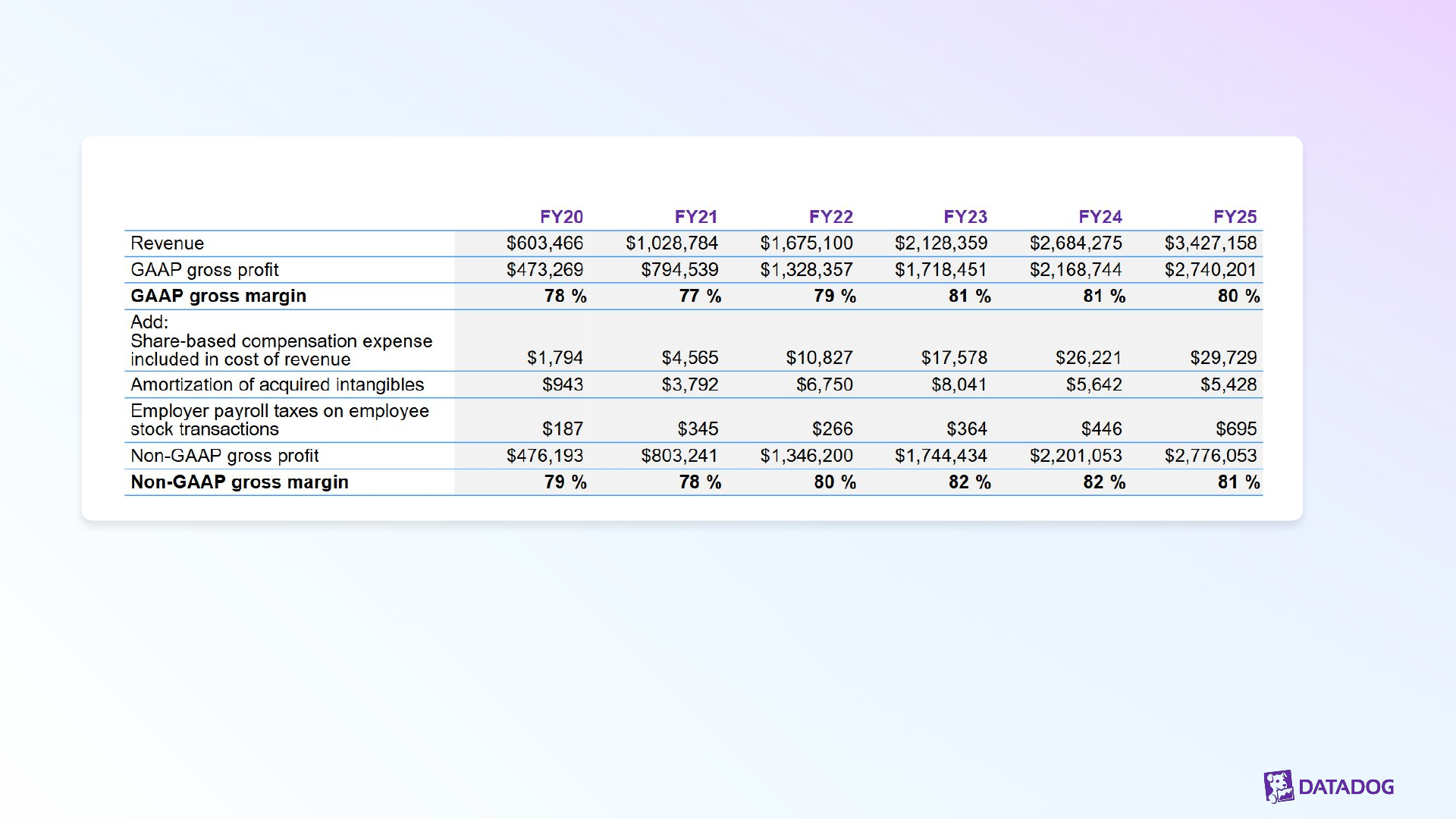
GAAP to Non-GAAP reconciliation
Gross profit margin ($000's)
| FY20 | FY21 | FY22 | FY23 | FY24 | FY25 | |
|---|---|---|---|---|---|---|
| Revenue | $603,466 | $1,028,784 | $1,675,100 | $2,128,359 | $2,684,275 | $3,427,158 |
| GAAP gross profit | $473,269 | $794,539 | $1,328,357 | $1,718,451 | $2,168,744 | $2,740,201 |
| GAAP gross margin | 78% | 77% | 79% | 81% | 81% | 80% |
| Add: Share-based compensation expense included in cost of revenue | $1,794 | $4,565 | $10,827 | $17,578 | $26,221 | $29,729 |
| Amortization of acquired intangibles | $943 | $3,792 | $6,750 | $8,041 | $5,642 | $5,428 |
| Employer payroll taxes on employee stock transactions | $187 | $345 | $266 | $364 | $446 | $695 |
| Non-GAAP gross profit | $476,193 | $803,241 | $1,346,200 | $1,744,434 | $2,201,053 | $2,776,053 |
| Non-GAAP gross margin | 79% | 78% | 80% | 82% | 82% | 81% |
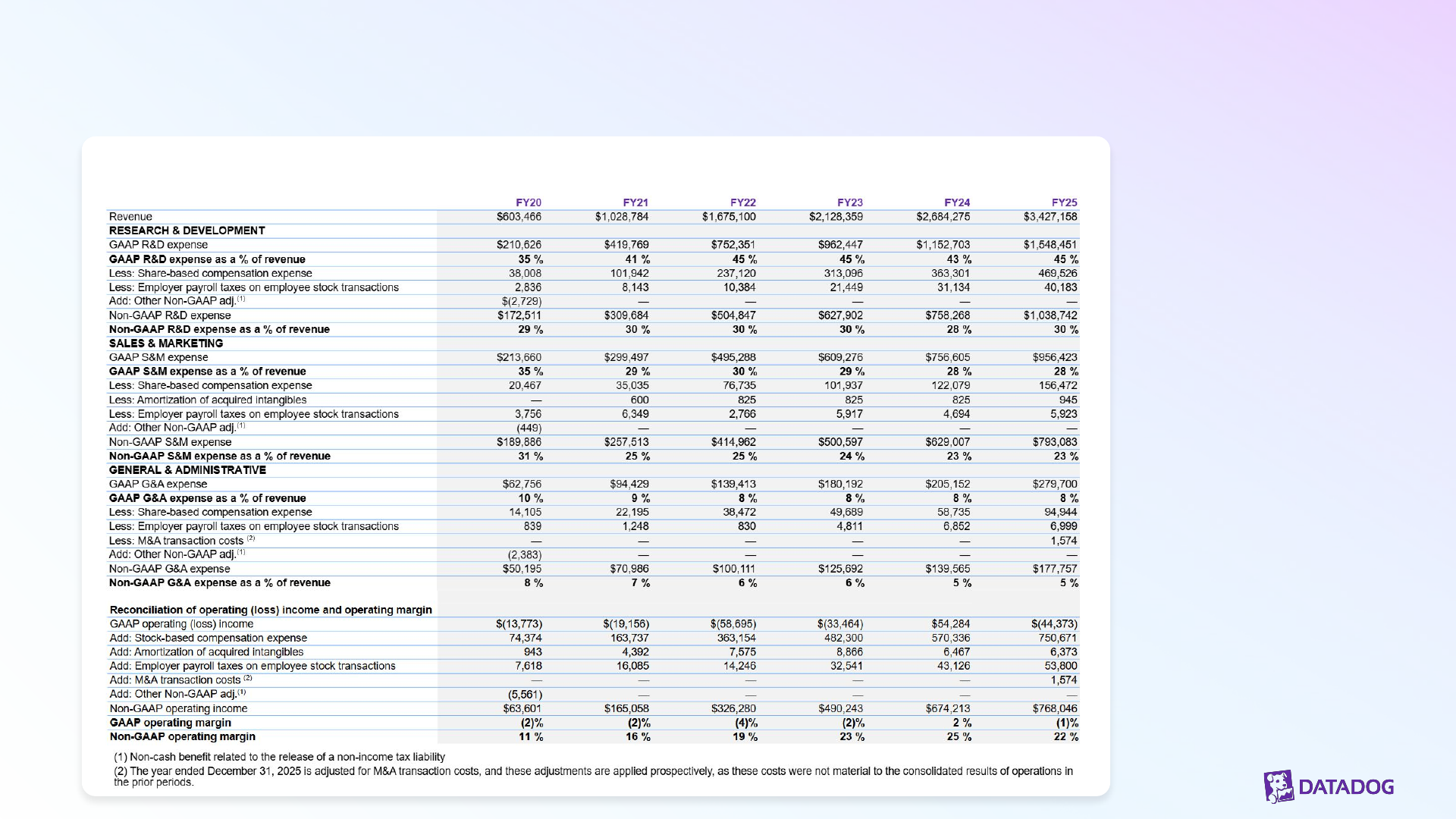
GAAP to Non-GAAP reconciliation
Operating expenses and operating profit ($000's)
| FY20 | FY21 | FY22 | FY23 | FY24 | FY25 | |
|---|---|---|---|---|---|---|
| Revenue | $603,466 | $1,028,784 | $1,675,100 | $2,128,359 | $2,684,275 | $3,427,158 |
| RESEARCH & DEVELOPMENT | ||||||
| GAAP R&D expense | $210,626 | $419,769 | $752,351 | $962,447 | $1,152,703 | $1,548,451 |
| GAAP R&D expense as a % of revenue | 35% | 41% | 45% | 45% | 43% | 45% |
| Less: Share-based compensation expense | 38,008 | 101,942 | 237,120 | 313,096 | 363,301 | 469,526 |
| Less: Employer payroll taxes on employee stock transactions | 2,836 | 8,143 | 10,384 | 21,449 | 31,134 | 40,183 |
| Add: Other Non-GAAP adj.(1) | $(2,729) | — | — | — | — | — |
| Non-GAAP R&D expense | $172,511 | $309,684 | $504,847 | $627,902 | $758,268 | $1,038,742 |
| Non-GAAP R&D expense as a % of revenue | 29% | 30% | 30% | 30% | 28% | 30% |
| SALES & MARKETING | ||||||
| GAAP S&M expense | $213,660 | $299,497 | $495,288 | $609,276 | $756,605 | $956,423 |
| GAAP S&M expense as a % of revenue | 35% | 29% | 30% | 29% | 28% | 28% |
| Less: Share-based compensation expense | 20,467 | 35,035 | 76,735 | 101,937 | 122,079 | 156,472 |
| Less: Amortization of acquired intangibles | — | 600 | 825 | 825 | 825 | 945 |
| Less: Employer payroll taxes on employee stock transactions | 3,756 | 6,349 | 2,766 | 5,917 | 4,694 | 5,923 |
| Add: Other Non-GAAP adj.(1) | (449) | — | — | — | — | — |
| Non-GAAP S&M expense | $189,886 | $257,513 | $414,962 | $500,597 | $629,007 | $793,083 |
| Non-GAAP S&M expense as a % of revenue | 31% | 25% | 25% | 24% | 23% | 23% |
| GENERAL & ADMINISTRATIVE | ||||||
| GAAP G&A expense | $62,756 | $94,429 | $139,413 | $180,192 | $205,152 | $279,700 |
| GAAP G&A expense as a % of revenue | 10% | 9% | 8% | 8% | 8% | 8% |
| Less: Share-based compensation expense | 14,105 | 22,195 | 38,472 | 49,689 | 58,735 | 94,944 |
| Less: Employer payroll taxes on employee stock transactions | 839 | 1,248 | 830 | 4,811 | 6,852 | 6,999 |
| Less: M&A transaction costs(2) | — | — | — | — | — | 1,574 |
| Add: Other Non-GAAP adj.(1) | (2,383) | — | — | — | — | — |
| Non-GAAP G&A expense | $50,195 | $70,986 | $100,111 | $125,692 | $139,565 | $177,757 |
| Non-GAAP G&A expense as a % of revenue | 8% | 7% | 6% | 6% | 5% | 5% |
| Reconciliation of operating (loss) income and operating margin | ||||||
| GAAP operating (loss) income | $(13,773) | $(19,156) | $(58,695) | $(33,464) | $54,284 | $(44,373) |
| Add: Stock-based compensation expense | 74,374 | 163,737 | 363,154 | 482,300 | 570,336 | 750,671 |
| Add: Amortization of acquired intangibles | 943 | 4,392 | 7,575 | 8,866 | 6,467 | 6,373 |
| Add: Employer payroll taxes on employee stock transactions | 7,618 | 16,085 | 14,246 | 32,541 | 43,126 | 53,800 |
| Add: M&A transaction costs(2) | — | — | — | — | — | 1,574 |
| Add: Other Non-GAAP adj.(1) | (5,561) | — | — | — | — | — |
| Non-GAAP operating income | $63,601 | $165,058 | $326,280 | $490,243 | $674,213 | $768,046 |
| GAAP operating margin | (2)% | (2)% | (4)% | (2)% | 2% | (1)% |
| Non-GAAP operating margin | 11% | 16% | 19% | 23% | 25% | 22% |
(1) Non-cash benefit related to the release of a non-income tax liability (2) The year ended December 31
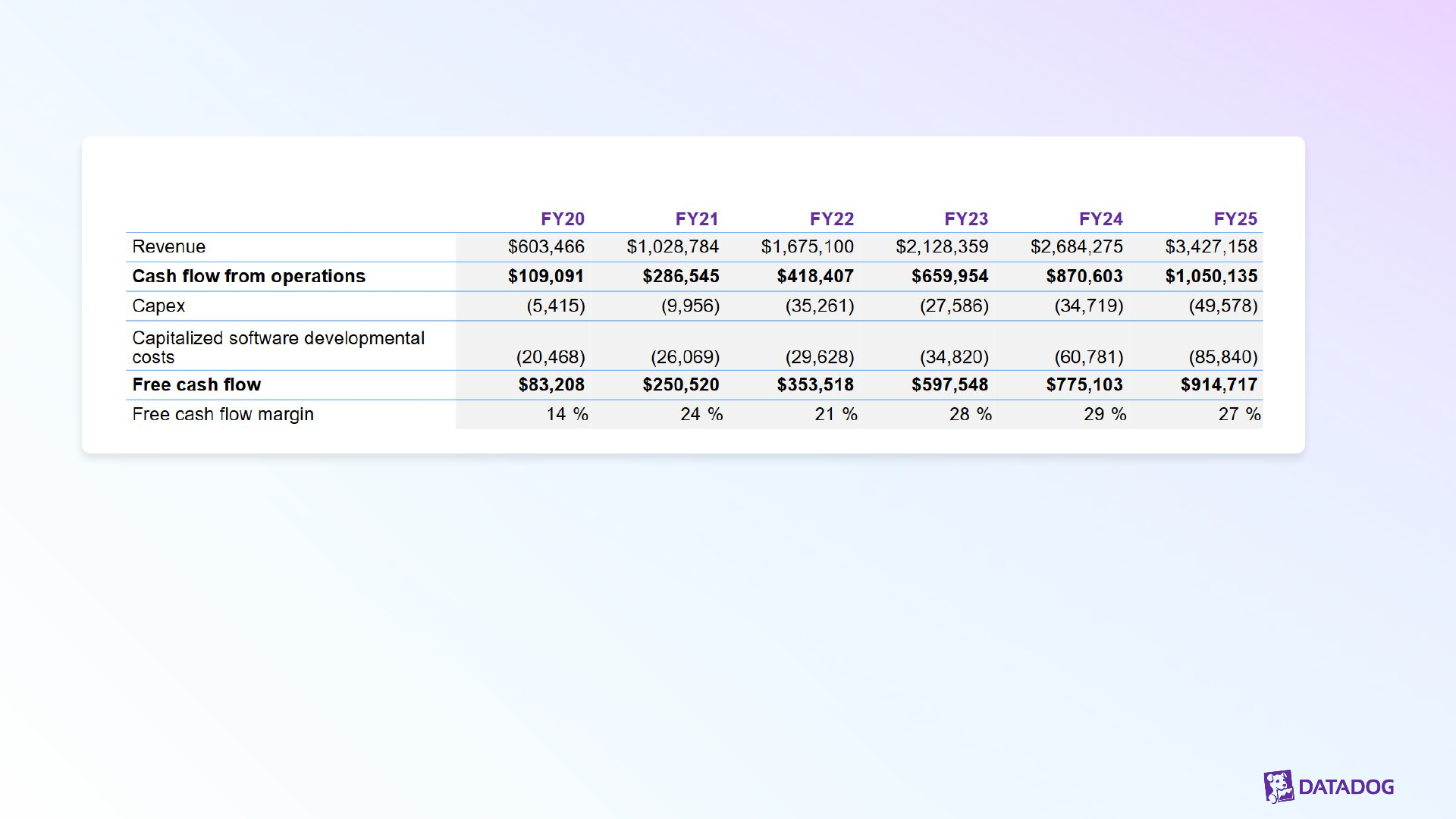
Free cash flow bridge
34
Free cash flow ($000’s)